
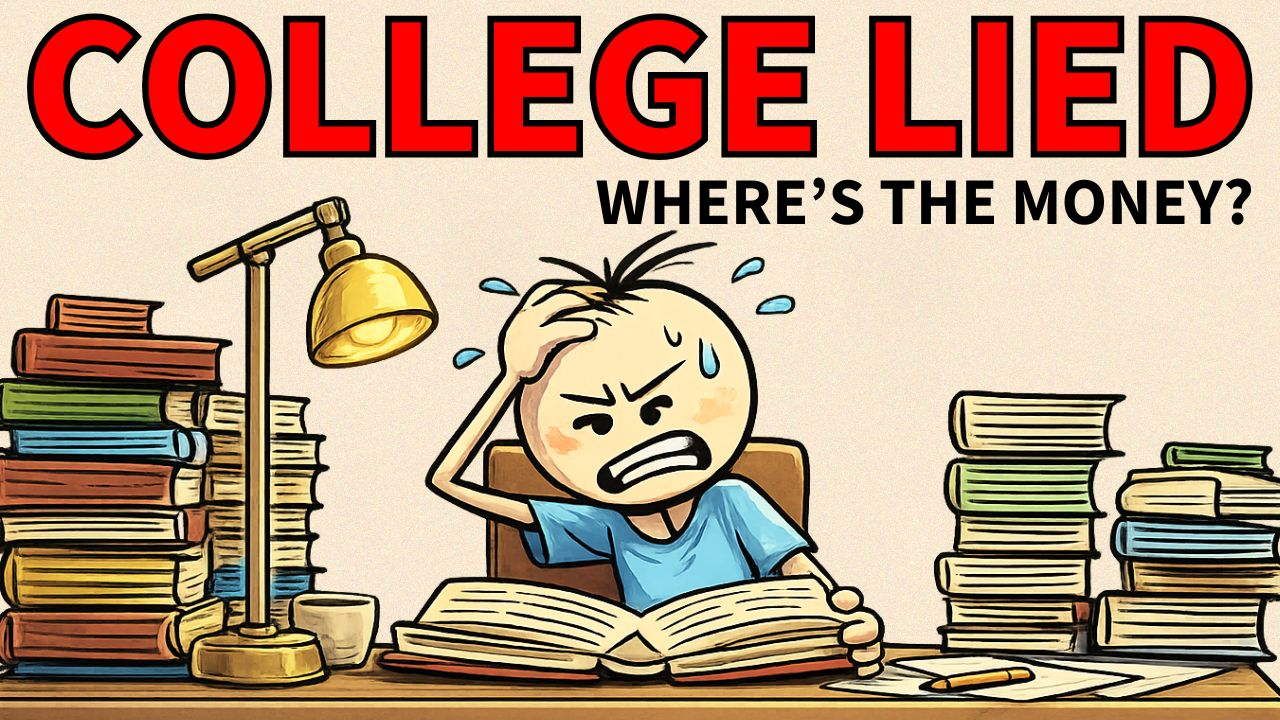
You followed the script perfectly. Good grades in high school. SAT prep courses. College applications. Maybe even grad school. You did everything right, checked every box, and earned that degree.
So where’s the wealth?
If you’re drowning in student loans, stuck in a job that barely covers rent, and watching high school friends who skipped college out-earn you, you’re not alone. And you’re not crazy for feeling lied to.
The uncomfortable truth is that your degree was never a golden ticket to wealth. It was just a piece of paper—one that cost you tens of thousands of dollars and four years of your life. The real question isn’t whether college was worth it. It’s what you do next.
Join our newsletter and subscribe to the channel!
The College-to-Wealth Pipeline Broke (And Nobody Told You)
For decades, the formula was simple: get a degree, get a good job, build wealth. That worked brilliantly when only 10% of Americans had bachelor’s degrees. Today, nearly 40% do.
When everyone has a degree, nobody has an advantage.
The data tells a brutal story. The median student loan debt is now $37,000. Meanwhile, the average starting salary for college graduates is around $55,000—barely enough to cover loan payments, rent, and basic living expenses in most cities. After taxes and that loan payment, you’re lucky to save anything.
Compare that to someone who skipped college, started working at 18, and spent those four years building skills, earning money, and avoiding debt. By 22, they might be a manager, a skilled tradesperson earning $70,000+, or even running their own small business. No debt. Four years of compounding career growth and savings.
The gap widens from there.
Your Degree Is Just Table Stakes
Here’s what college actually gave you: permission to apply for certain jobs.
That’s it. Not wealth. Not guaranteed employment. Just the ability to get past HR filters that require “Bachelor’s degree or equivalent experience.”
Think about what that means. You spent $100,000+ and four years to meet the minimum requirements for jobs that might pay $55,000. The degree didn’t make you wealthy—it just made you eligible to start the race everyone else is already running.
The real wealth builders? They’re not relying on their degrees. They’re leveraging skills, networks, business ownership, and strategic career moves. Their diploma might be hanging on the wall, but it’s not what’s padding their bank account.
What Actually Builds Wealth (Spoiler: It’s Not Your Diploma)
Let’s get clear on what separates the wealthy from the degree-holders treading water:
Income optimization matters more than credentials. A plumber with 10 years of experience can easily earn $80,000-$100,000. A licensed electrician? Same story. Meanwhile, plenty of bachelor’s degree holders are stuck at $50,000-$60,000 because they chose fields with low market demand.
Your earning potential isn’t about your degree—it’s about the economic value you create. The market doesn’t care about your GPA or how prestigious your university was. It cares whether you solve expensive problems.
Ownership beats employment, always. Employees trade time for money. Business owners and investors make money while they sleep. This is the single biggest wealth gap that college never taught you about.
The person who started a pressure-washing business instead of going to college might clear $150,000 a year with three employees and systematized operations. The marketing major working at an agency? Maybe $65,000, with a ceiling around $100,000 unless they make partner.
Debt is wealth’s kryptonite. If you’re paying $400-$800 monthly on student loans for the next decade, that’s $48,000-$96,000 that’s NOT going into investments, real estate, or business opportunities. That’s not just lost payments—it’s lost compounding returns.
Someone who avoided student debt and invested $500/month from age 22 to 32 would have roughly $78,000 (assuming 8% returns). The college grad paying off loans? They’re at zero, hoping to start investing in their 30s.
Financial literacy trumps academic knowledge. College taught you about Renaissance literature or organic chemistry. It didn’t teach you about tax strategies, investment vehicles, or how to negotiate your salary.
The wealthy understand tax-advantaged accounts, asset allocation, real estate investing, and how to make their money work for them. They learned this outside of college—because college doesn’t teach wealth building, it teaches credential acquisition.
The Fields Where Degrees Actually Matter
Let’s be fair: some degrees do lead to wealth—but fewer than you think.
Engineering, computer science, and certain healthcare fields have strong ROI. A software engineer can start at $100,000+ with a bachelor’s degree. Nurses, pharmacists, and physicians (who need specific credentials) command high salaries.
But even here, the degree alone isn’t enough. The successful software engineer isn’t succeeding because of their diploma—they’re succeeding because they can code, solve problems, and ship products. The degree just opened the door.
And plenty of self-taught developers are making the same money (or more) than their degreed peers. They proved their skills through portfolios and projects, not expensive universities.
The Real Cost of Following the College Script
Let’s do some uncomfortable math.
Scenario A: College Path
- Ages 18-22: Accumulate $80,000 in debt, earn $0
- Age 22: Start at $55,000/year
- Student loan payment: $800/month
- After 10 years (age 32): Loans paid off, maybe $50,000 saved if disciplined
Scenario B: No College Path
- Age 18: Start working, earning $35,000
- Ages 18-22: Earn $160,000 total (with raises), save/invest $40,000
- Age 22: Earning $50,000 in skilled trade or sales
- No debt, continue saving $800/month
- After 10 years (age 32): Approximately $150,000 in savings/investments
The person who skipped college is $100,000+ ahead by age 32—even starting with a lower salary. And that’s assuming the college grad got a decent job immediately and stayed disciplined with money.
This isn’t anti-education. It’s anti-blindly-following-an-expensive-script-that-doesn’t-deliver-what-it-promised.
Breaking Free from the Degree Mindset
If you already have your degree and the debt that came with it, here’s your path forward:
Treat your degree as a sunk cost. You can’t get that time or money back. Don’t let it define your future decisions. Don’t stay in a low-paying job just because it’s “related to your major.” The degree is done—focus on optimizing from where you are now.
Develop high-income skills aggressively. Sales, digital marketing, coding, project management, data analysis—these skills translate directly to higher paychecks. Many can be learned for free or cheap online. Your degree gave you critical thinking and work ethic; now add market-valuable skills on top.
Pay off that debt like your wealth depends on it—because it does. Every dollar going to student loans is a dollar not building wealth. Attack that debt with intensity. Side hustles, aggressive budgeting, whatever it takes. Freedom from debt is the foundation of wealth building.
Think like an owner, not an employee. Even if you’re working a 9-to-5, start thinking about business opportunities. Freelancing. Consulting. Small business ownership. The wealth gap between top employees and modest business owners is staggering.
Invest in assets, not more credentials. Don’t fall into the trap of thinking another degree or certification will save you. Unless it’s directly required for a high-paying field, you’re better off investing that money in index funds, real estate, or a business.
The Bottom Line: Education vs. Wealth Building
College can be valuable. It offers experiences, networks, and knowledge that can enrich your life. For certain careers, it’s required.
But let’s stop pretending it’s a wealth-building strategy. It’s not.
Wealth comes from earning more than you spend, investing the difference, avoiding debt, building equity (in businesses or real estate), and making strategic career moves. Your degree might help with some of that. Or it might not.
The sooner you accept that your diploma won’t make you rich, the sooner you can focus on the things that actually will: valuable skills, smart financial decisions, and building assets that generate income.
College didn’t lie about education. It lied about wealth. Now you know the difference.
The question is: what will you do about it?
Related Articles:
- 12 Signs You’re Actually Ahead – Even if it Doesn’t Feel Like It
- Financial Compatibility in Dating: The Money Talk That Can Save You Years of Pain
- Median Income by Age (2025 Data + How to Earn More)
- Average Net Worth by Age (2025 Data + How to Catch Up)
- Fake Rich Exposed: 10 Signs Someone Is Pretending to Be Wealthy
- Build Wealth in Your 20s: 7 Simple Steps to Your First Million
- How to Save $10K in 2026 : 10 Realistic Steps (Starting from $0)
- How to Save Your First $100,000 in 2026: A Complete Guide
Frequently Asked Questions
Does a college degree still have value?
Yes, but not for wealth building in most cases. A degree provides access to certain careers, credentialing for regulated professions, and potential networking opportunities. However, the degree itself doesn’t create wealth—your skills, financial decisions, and career strategy do.
What percentage of millionaires have college degrees?
Approximately 88% of millionaires have bachelor’s degrees. However, correlation isn’t causation. Many built wealth through business ownership, strategic investing, and high-income skills—not because of their degrees. The degree was often incidental to their wealth journey.
Are trade jobs really more profitable than degree-requiring jobs?
It depends on the specific career, but skilled trades often offer better ROI. Electricians, plumbers, and HVAC technicians can earn $70,000-$100,000+ without student debt and with four years of career advancement while peers are in college. Over a lifetime, the math often favors trades when you factor in debt avoidance.
Should I go to college if I want to be wealthy?
Only if you’re pursuing a high-ROI field (engineering, computer science, healthcare with clear career paths) or if you’re certain about a career requiring credentials. Otherwise, consider alternatives: trade schools, online skill development, entrepreneurship, or starting work immediately. Wealth is built through income optimization and smart investing, not expensive credentials.
How can I build wealth if I already have student loan debt?
Focus on three priorities: (1) Aggressively pay down high-interest debt while maintaining minimum payments on federal loans with lower rates, (2) Develop high-income skills that increase your earning potential, and (3) Start investing at least something monthly, even if small, to build the habit. The key is attacking the debt while simultaneously building income and assets—not waiting until loans are paid off to start building wealth.