
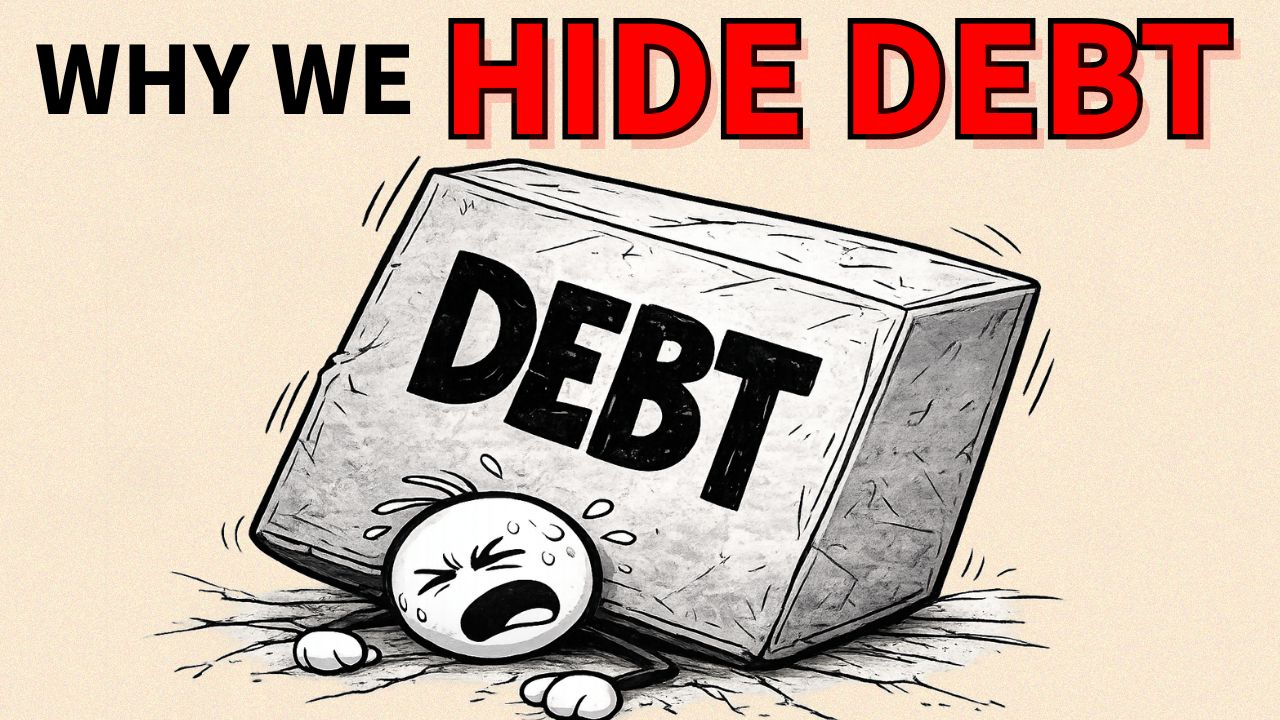
You’ve probably felt it before—that tight knot in your stomach when a friend mentions their vacation fund while you’re drowning in credit card debt. Or the way you deflect when someone asks about your financial goals, because admitting you’re barely keeping up feels impossible.
Here’s what most people don’t realize: 73% of Americans rank their finances as the number one source of stress in their lives, yet fewer than 40% feel comfortable discussing money problems with even their closest friends. This gap between how many people struggle and how few talk about it? That’s debt shame in action.
Debt shame isn’t just an uncomfortable feeling—it’s a psychological barrier that prevents millions of people from taking the exact steps that would improve their financial situation. And the silence surrounding it makes the problem exponentially worse.
Join our newsletter and subscribe to the channel!
What Is Debt Shame?
Debt shame is the internalized feeling of failure, embarrassment, or moral inadequacy that people experience because of their debt. It goes beyond simply wishing you had less debt—it’s the deep-seated belief that your debt makes you a bad person, a failure, or someone fundamentally broken.
Unlike healthy financial concern (which motivates action), debt shame paralyzes. It convinces you that your situation is uniquely terrible, that you’ve failed in ways others haven’t, and that you should hide your struggle rather than address it.
The psychological weight is real. A 2023 study published in the Journal of Financial Therapy found that individuals experiencing high levels of financial shame were 2.5 times more likely to avoid opening bills or checking account balances—the exact opposite of the financial engagement that could help them improve their situation.
The Data Behind Debt Shame
The numbers paint a stark picture of how widespread—and hidden—debt shame actually is.
How Common Is Debt?
First, let’s establish the baseline: 77% of American households carry some form of debt, according to the Federal Reserve’s 2024 Survey of Consumer Finances. The average U.S. household with debt owes approximately $145,000, including mortgages, auto loans, credit cards, and student loans.
Breaking this down by category:
- Average credit card debt per household: $7,951
- Average student loan debt: $38,792
- Average auto loan debt: $23,792
- Average mortgage debt: $244,498
These aren’t outlier numbers—they’re the norm. Yet despite debt being statistically normal, the shame associated with it remains stubbornly high.
The Silence Around Financial Struggle
Here’s where things get interesting. Research from CreditCards.com found that 37% of Americans have lied about their finances to someone close to them, with debt being the most commonly hidden financial fact. Another study revealed that people are more comfortable discussing their political views, mental health struggles, or even sexual history than their credit card debt.
Why? Because we’ve internalized debt as a moral failing rather than a mathematical problem.
A Bankrate survey discovered that 42% of Americans with debt feel “significant shame” about it, and this shame intensifies with age. Millennials and Gen Z report lower levels of debt shame compared to Gen X and Boomers, possibly because younger generations have normalized discussing financial struggles more openly on social media.
The Mental Health Connection
The psychological impact of debt shame extends far beyond discomfort. Researchers at the University of Nottingham found that people with problem debt are three times more likely to have considered suicide compared to those without debt problems—not necessarily because of the debt amount itself, but because of the shame, isolation, and hopelessness that accompany it.
Additional research shows:
- 46% of people with debt report it negatively impacts their mental health
- 56% say debt causes relationship stress
- 62% experience physical symptoms like headaches or insomnia related to financial anxiety
The shame creates a vicious cycle: debt causes stress, stress increases shame, shame prevents action, inaction worsens debt.
Why Debt Shame Is So Powerful
Several cultural and psychological factors make debt shame particularly potent in modern society.
The “Bootstraps” Mentality
American culture heavily emphasizes individual responsibility and self-sufficiency. We celebrate rags-to-riches stories while stigmatizing financial struggle as personal failure. This cultural narrative suggests that if you’re in debt, you simply didn’t work hard enough, weren’t disciplined enough, or made poor choices.
The reality is far more complex. Medical debt alone affects 41% of American adults, according to the Kaiser Family Foundation. Student loan debt reflects rising education costs that have outpaced income growth by 170% over the past 30 years. These aren’t individual moral failings—they’re systemic issues affecting millions.
Social Comparison in the Instagram Age
Social media has amplified debt shame exponentially. When your feed is filled with friends posting vacation photos, home purchases, and lifestyle upgrades, it’s easy to feel like everyone else has their finances figured out.
But here’s the truth: 68% of people admit they’ve posted about purchases they couldn’t actually afford to maintain appearances. The highlight reel you’re comparing yourself to is often just as financially precarious as your own situation—you just can’t see the credit card bills behind the brunch photos.
Financial Literacy Gaps
Many people feel shame about debt because they believe they “should” understand money better. Yet studies show that only 57% of American adults are financially literate, and financial education is rarely taught comprehensively in schools.
Not knowing how to manage debt isn’t a character flaw—it’s an educational gap. But shame makes us internalize it as stupidity rather than recognizing it as a skill we were never taught.
The Dangerous Consequences of Debt Shame
When shame drives financial behavior, the consequences compound quickly.
Avoidance Behaviors
Debt shame triggers avoidance. Financial therapists report that “financial avoidance” is one of the most common destructive behaviors they see in clients struggling with debt. This includes:
- Not opening bills or bank statements
- Avoiding phone calls from creditors
- Refusing to create a budget because “it will just make me feel worse”
- Ignoring debt collectors until legal action becomes necessary
Each avoidance behavior makes the situation worse. Interest compounds, fees accumulate, and opportunities for negotiation or assistance pass by.
Relationship Damage
Money arguments are the second leading cause of divorce in America, according to research from Ramsey Solutions. But often it’s not the debt itself that destroys relationships—it’s the shame-driven secrecy around it.
When one partner hides debt from another, the eventual discovery damages trust far more than the debt amount ever could. The shame that prevented honest conversation becomes the catalyst for relationship breakdown.
Missed Opportunities for Help
Perhaps most tragically, debt shame prevents people from seeking help when it’s available. Many people in severe financial distress don’t know that nonprofit credit counseling services exist, or that debt settlement and bankruptcy can provide legitimate paths forward.
Others qualify for income-driven repayment plans, hardship programs, or assistance programs they never pursue because shame convinces them they don’t deserve help or that seeking it would be admitting defeat.
Breaking Free from Debt Shame
The good news? Debt shame can be overcome, and doing so is often the first step toward actually resolving debt.
Normalize the Conversation
Start small. You don’t need to broadcast your financial situation on social media, but being honest with one trusted friend can be revolutionary. Research shows that people who discuss money openly with at least one person report significantly lower financial stress than those who stay silent.
Join online communities where people discuss debt payoff journeys openly. The r/personalfinance and r/DaveRamsey subreddits have millions of members sharing their struggles and progress. Reading others’ stories helps you realize you’re not alone or uniquely broken.
Separate Identity from Numbers
Your debt is a number, not a character judgment. Financial therapist Amanda Clayman emphasizes that “debt is a tool that didn’t work well for you—not evidence of who you are as a person.”
Would you feel shame about a tool that broke? Would you define yourself by a math problem that was harder than expected? Debt is a financial circumstance that can be changed, not a permanent identity.
Focus on Direction, Not Position
Instead of obsessing over how much you owe, focus on the trend line. Research on habit formation shows that celebrating progress—even tiny progress—is more motivating than fixating on the end goal.
Paid off $100 this month? That’s progress. Spent $50 less on eating out? That’s movement in the right direction. The gap between where you are and where you want to be will always feel overwhelming if you only look at the total—but the delta between last month and this month? That’s actionable and achievable.
Seek Professional Help Without Apology
If your debt feels unmanageable, talking to a certified financial counselor or financial therapist isn’t weakness—it’s the smartest possible move. The National Foundation for Credit Counseling reports that people who complete credit counseling save an average of $100/month and pay off debt 40% faster than those who don’t.
Mental health professionals who specialize in financial therapy can help you untangle the emotional components of debt shame while financial professionals create actionable debt payoff plans.
The Path Forward
Debt shame thrives in silence and isolation. It tells you that your struggle is unique, that everyone else has it figured out, and that your situation is too shameful to discuss.
The data tells a different story. Debt is common, financial struggle is normal, and the shame you feel is a shared human experience—not a reflection of your worth or capabilities.
The moment you recognize debt shame for what it is—a psychological barrier rather than a reasonable response—you can begin to dismantle it. Talk about it. Seek help. Make a plan. Take one small action.
Your debt doesn’t define you. Your willingness to confront it, shame and all, is what makes the difference.
Related Articles:
- 12 Signs You’re Actually Ahead – Even if it Doesn’t Feel Like It
- Financial Compatibility in Dating: The Money Talk That Can Save You Years of Pain
- Median Income by Age (2025 Data + How to Earn More)
- Average Net Worth by Age (2025 Data + How to Catch Up)
- Fake Rich Exposed: 10 Signs Someone Is Pretending to Be Wealthy
- Build Wealth in Your 20s: 7 Simple Steps to Your First Million
- How to Save $10K in 2026 : 10 Realistic Steps (Starting from $0)
- How to Save Your First $100,000 in 2026: A Complete Guide
Frequently Asked Questions
What is debt shame?
Debt shame is the internalized feeling of failure, embarrassment, or moral inadequacy people experience because of their debt. It goes beyond normal financial concern and often prevents people from taking action to improve their situation.
How common is debt in America?
77% of American households carry some form of debt. The average household with debt owes approximately $145,000 across mortgages, auto loans, credit cards, and student loans.
Does debt shame affect mental health?
Yes. Research shows that people with problem debt are three times more likely to have considered suicide, and 46% of people with debt report it negatively impacts their mental health.
How can I overcome debt shame?
Start by talking about your situation with one trusted person, separate your identity from your debt amount, focus on progress rather than perfection, and consider working with a certified financial counselor or financial therapist.
Is it normal to hide debt from friends and family?
While common (37% of Americans have lied about their finances), hiding debt often increases shame and prevents you from getting support that could help. Financial honesty, at least with select trusted individuals, typically reduces shame and stress.